Begin with the outing
Before comparing cameras, describe your likely day. A short visit to a public wetland, a long woodland walk, and a supervised monitoring session place different demands on equipment. Consider the walking surface, available shelter, time outdoors, and whether you need your hands free. An impressive lens that stays in the car is not a useful field tool.
Make a list of situations your current kit handles poorly. Separate a genuine limitation, such as an unreliable battery, from a skill you can practise, such as finding a moving subject in the viewfinder. Borrowing or renting may help you evaluate a change without treating a specification sheet as a promise of better photographs.
Compare trade-offs, not rankings
Phone or compact camera
Useful for habitat, tracks photographed without disturbance, and wider scenes. Small distant subjects may not provide enough detail for confident identification. Digital enlargement cannot recover information that was never recorded.
Interchangeable camera with a moderate telephoto
Offers more framing control while remaining reasonably portable. Assess autofocus, handling, and total weight together. A lens that is easy to support may yield steadier results than a longer lens you struggle to hold.
Long lens and support
Can preserve distance and isolate detail, but adds weight and setup time. Tripod legs must not block paths, damage vegetation, or create hazards for other visitors. Longer reach never grants permission to cross a boundary.
Focal length describes a lens’s optical property, not a guaranteed subject size. Sensor dimensions, subject distance, and the final crop all affect framing. Rather than chasing a single number, practise finding and following subjects at the distances your location permits.
Test the controls before the trail
Learn how to change shutter speed, exposure compensation, and focus area without long menu searches. Shutter speed controls the time each exposure records; exposure compensation asks an automatic exposure mode for a brighter or darker result. Check your camera manual because available controls and their behavior vary.
Test mechanical and electronic shutter modes on ordinary moving subjects. Electronic shutters can be quiet, but some models distort fast movement or produce banding under certain lights. “Silent” also describes only the camera: your clothing, bag, footsteps, and position remain noticeable to wildlife.
Practise short bursts instead of holding the release continuously. Review whether the subject is sharp and whether important bright detail is lost. The purpose is a familiar routine, not a collection of settings you assume will work in every habitat.
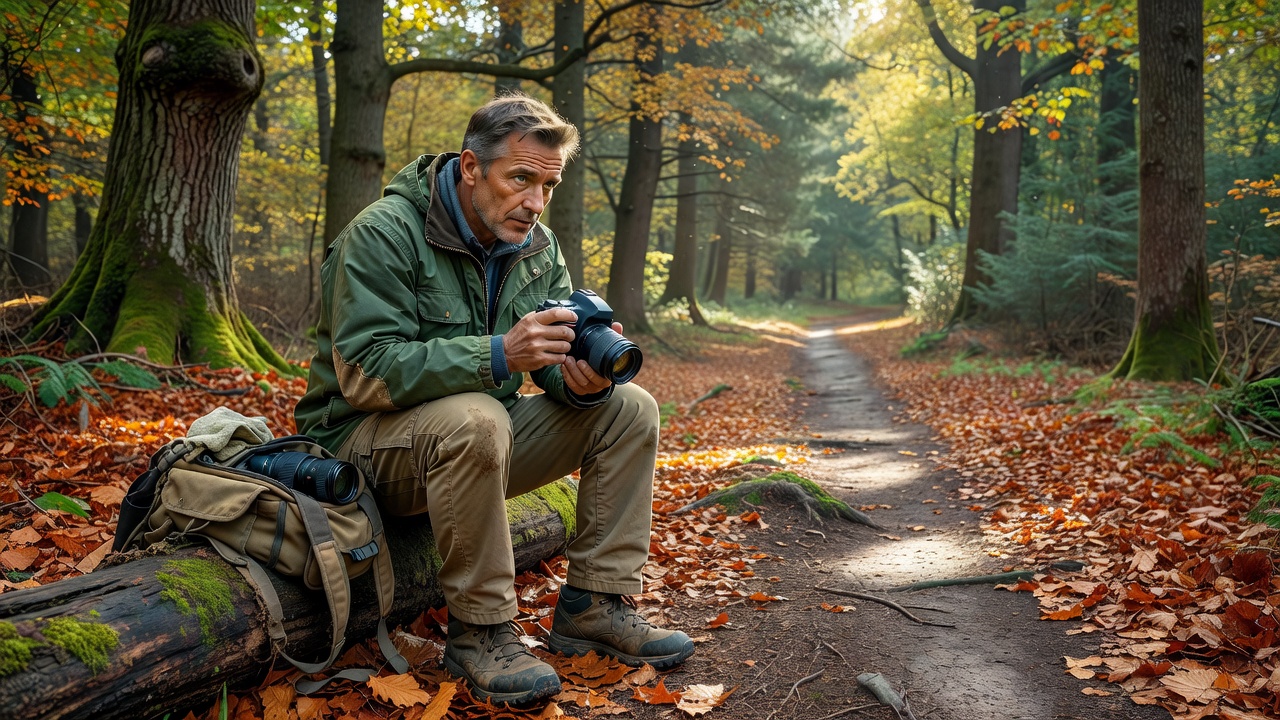
Pack the quiet essentials
Carry charged spare power, sufficient memory, a clean lens cloth, suitable weather protection, and a way to keep notes. Water, appropriate clothing, navigation, and any required personal medication come before an extra lens. Do not mistake a camera bag’s weather resistance for a safety plan.
A notebook is especially useful when photographs omit context. Record the date, approximate observation time and time zone, habitat, weather, and uncertainty about identification. Synchronize the camera clock before leaving. Keep precise sensitive locations out of anything likely to be shared publicly.
For damp conditions, follow the manufacturer’s care guidance and avoid opening equipment unnecessarily. A rain cover should not flap loudly or shed material. Pack out lens wipes and damaged accessories, and inspect the place where you rested your bag before moving on.
Review the day, not the shopping list
After a few outings, ask what the equipment helped you notice and what distracted you. Was the load comfortable? Could you remain on a permitted route? Did you spend longer adjusting equipment than observing? These answers are more useful than comparing your results with heavily selected images online.
Build a repeatable packing list, then remove items that solve no recurring problem. When an upgrade is justified, choose the smallest change that addresses the actual limitation. Keep original files and backups, and avoid implying that equipment alone makes a record reliable. Context, restraint, and honest identification still do most of the work.
Reference checks
- Your camera and lens manufacturer’s manuals: authoritative sources for mode limitations and weather-care instructions.
- Audubon’s guide to ethical bird photography: practical context for equipment decisions around birds.
- National Park Service wildlife watching guidance: a reminder to check rules at the actual place you visit.